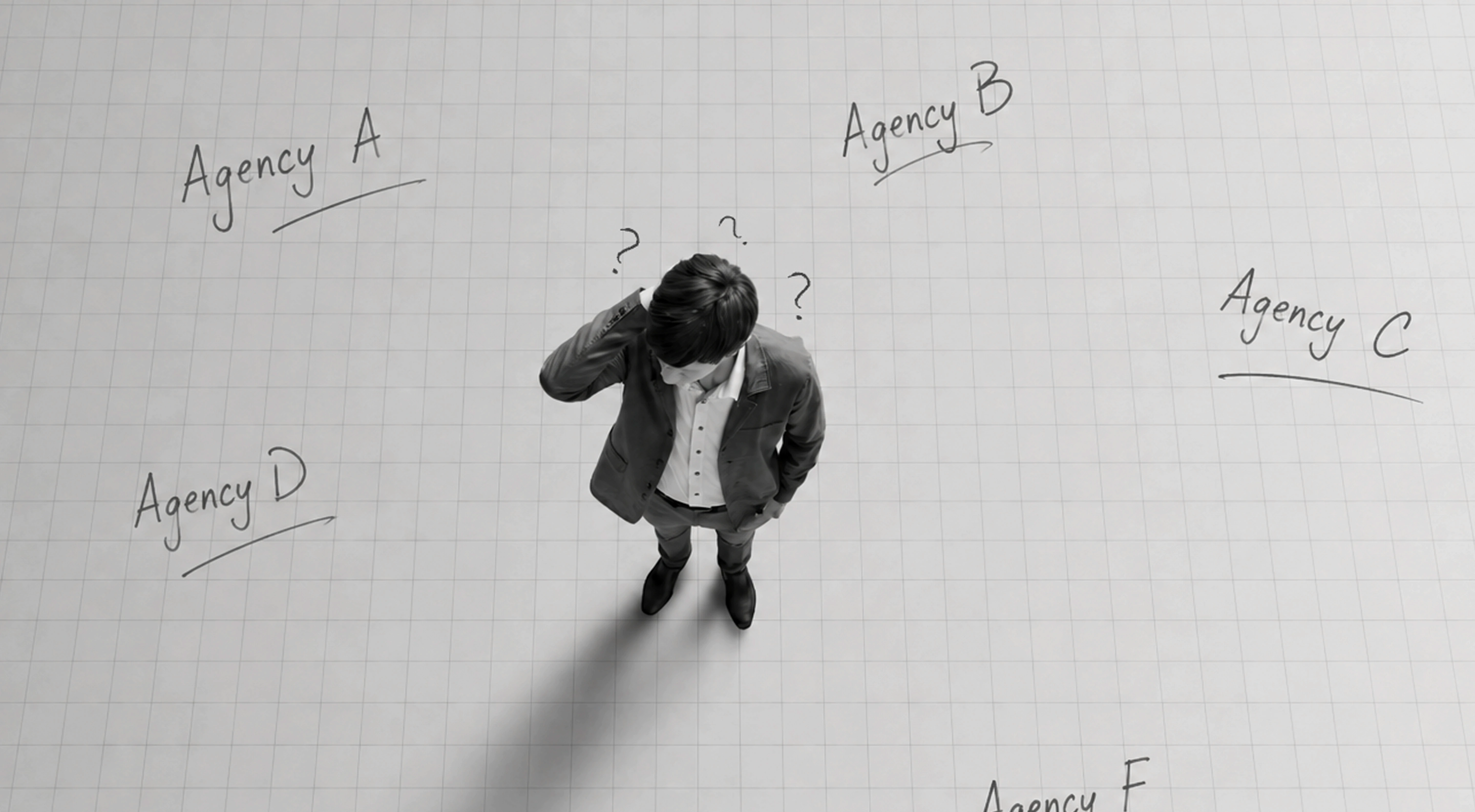


How to Choose a Brand Identity Design Agency
How to Choose a Brand Identity Design Agency
How to Choose a Brand Identity Design Agency
Published
Published
August 06, 2026
August 06, 2026
Read time
Read time
8 min
8 min
The Five Things That Actually Matter
The Five Things That Actually Matter
The Five Things That Actually Matter
If you are deciding how to choose a branding agency, focus on five criteria that directly affect the quality of the project and the working relationship:
Scope fit — Can the agency handle the strategy, identity system, applications, and documentation you actually need?
Quality of thinking — Does its work show clear reasoning behind creative decisions?
Process — Are the stages, deliverables, feedback points, and responsibilities clearly defined?
Commercial clarity — Are costs, revisions, timelines, licensing, and IP ownership transparent?
Working relationship — Can the team communicate clearly, challenge assumptions, and work effectively with your stakeholders?
One factor people often overvalue is visual style.
A beautiful portfolio can demonstrate craft, but a signature aesthetic is not necessarily the best predictor of your project's outcome. If every client ends up looking similar, the agency may be applying its own style rather than building an identity around each business.
The best branding agency criteria combine strong creative work with strategic thinking, a reliable process, transparent terms, and evidence that the team can solve different brand problems.
If you are deciding how to choose a branding agency, focus on five criteria that directly affect the quality of the project and the working relationship:
Scope fit — Can the agency handle the strategy, identity system, applications, and documentation you actually need?
Quality of thinking — Does its work show clear reasoning behind creative decisions?
Process — Are the stages, deliverables, feedback points, and responsibilities clearly defined?
Commercial clarity — Are costs, revisions, timelines, licensing, and IP ownership transparent?
Working relationship — Can the team communicate clearly, challenge assumptions, and work effectively with your stakeholders?
One factor people often overvalue is visual style.
A beautiful portfolio can demonstrate craft, but a signature aesthetic is not necessarily the best predictor of your project's outcome. If every client ends up looking similar, the agency may be applying its own style rather than building an identity around each business.
The best branding agency criteria combine strong creative work with strategic thinking, a reliable process, transparent terms, and evidence that the team can solve different brand problems.
Step 1: Define Your Scope and Budget First
Step 1: Define Your Scope and Budget First
Step 1: Define Your Scope and Budget First
Before comparing agencies, define what you are actually asking them to deliver.
Without a clear scope of work, two agencies may send completely different proposals. One may quote for a logo and basic visual identity, while another includes research, positioning, a full identity system, guidelines, templates, and rollout support.
Comparing those prices without comparing scope tells you very little.
Before comparing agencies, define what you are actually asking them to deliver.
Without a clear scope of work, two agencies may send completely different proposals. One may quote for a logo and basic visual identity, while another includes research, positioning, a full identity system, guidelines, templates, and rollout support.
Comparing those prices without comparing scope tells you very little.
Start With a Clear Brief
Start With a Clear Brief
Start With a Clear Brief
Before approaching an agency, your brief should explain:
What the business does
Who the primary audience is
Why the project is happening now
The problem the identity needs to solve
What already exists
Required deliverables
Important touchpoints
Desired timeline
Known launch date
Budget range
Key stakeholders and decision-maker
You do not need to solve the strategy before hiring an agency. Good agencies should help clarify unanswered questions during discovery. The brief simply needs to establish enough context for an accurate conversation and proposal.
Before approaching an agency, your brief should explain:
What the business does
Who the primary audience is
Why the project is happening now
The problem the identity needs to solve
What already exists
Required deliverables
Important touchpoints
Desired timeline
Known launch date
Budget range
Key stakeholders and decision-maker
You do not need to solve the strategy before hiring an agency. Good agencies should help clarify unanswered questions during discovery. The brief simply needs to establish enough context for an accurate conversation and proposal.
Set a Realistic Budget Range
Set a Realistic Budget Range
Set a Realistic Budget Range
If you have an approved budget range, share it.
Withholding the budget rarely creates a negotiating advantage. It often results in agencies designing a scope that is either far above or below what you can realistically invest.
A budget allows the supplier to recommend the right level of research, strategy, creative development, documentation, and rollout support.
If the budget is flexible, explain that too. Ask what changes between different levels of investment rather than requesting the lowest possible price.
If you have an approved budget range, share it.
Withholding the budget rarely creates a negotiating advantage. It often results in agencies designing a scope that is either far above or below what you can realistically invest.
A budget allows the supplier to recommend the right level of research, strategy, creative development, documentation, and rollout support.
If the budget is flexible, explain that too. Ask what changes between different levels of investment rather than requesting the lowest possible price.
Decide Who Has Final Approval
Decide Who Has Final Approval
Decide Who Has Final Approval
Define your internal approval structure before the first agency call.
Identify the final decision-maker and determine which stakeholders need to contribute at different stages. This becomes especially important when founders, marketing, product, sales, and leadership all have an interest in the project.
An unclear approval group can turn a straightforward project into repeated revision cycles.
When learning how to pick a brand identity agency, start by making your own requirements clear. Better inputs produce more accurate proposals and make it much easier to compare potential partners fairly.
Define your internal approval structure before the first agency call.
Identify the final decision-maker and determine which stakeholders need to contribute at different stages. This becomes especially important when founders, marketing, product, sales, and leadership all have an interest in the project.
An unclear approval group can turn a straightforward project into repeated revision cycles.
When learning how to pick a brand identity agency, start by making your own requirements clear. Better inputs produce more accurate proposals and make it much easier to compare potential partners fairly.
Step 2: Evaluate the Portfolio Properly
Step 2: Evaluate the Portfolio Properly
Step 2: Evaluate the Portfolio Properly
A strong portfolio matters, but evaluating it only by asking whether you like the work can lead to the wrong decision.
The better question is whether the agency demonstrates the ability to understand different problems and build appropriate identity systems around them.
A strong portfolio matters, but evaluating it only by asking whether you like the work can lead to the wrong decision.
The better question is whether the agency demonstrates the ability to understand different problems and build appropriate identity systems around them.
Look for Problem Relevance, Not Just Industry Relevance
Look for Problem Relevance, Not Just Industry Relevance
Look for Problem Relevance, Not Just Industry Relevance
An agency does not always need experience in your exact industry.
Relevant category experience can be useful, especially in highly specialised markets, but a strong project in an adjacent category may demonstrate more useful capabilities than a mediocre project in your own.
For example, if your challenge is moving a brand upmarket, look for a case study showing successful repositioning. If you are launching across digital and physical channels, look for an identity that works across both.
Focus on similarity of the problem, not simply similarity of the client.
An agency does not always need experience in your exact industry.
Relevant category experience can be useful, especially in highly specialised markets, but a strong project in an adjacent category may demonstrate more useful capabilities than a mediocre project in your own.
For example, if your challenge is moving a brand upmarket, look for a case study showing successful repositioning. If you are launching across digital and physical channels, look for an identity that works across both.
Focus on similarity of the problem, not simply similarity of the client.
Read the Reasoning Behind the Work
Read the Reasoning Behind the Work
Read the Reasoning Behind the Work
Good case studies should explain more than what was designed.
Look for evidence of:
The original business problem
Audience or market insight
Strategic thinking
Creative rationale
Important design decisions
How the identity was applied
What changed as a result
A page containing polished mockups may demonstrate visual ability, but it tells you little about why those decisions were made.
Strong work should connect the problem to the solution.
Good case studies should explain more than what was designed.
Look for evidence of:
The original business problem
Audience or market insight
Strategic thinking
Creative rationale
Important design decisions
How the identity was applied
What changed as a result
A page containing polished mockups may demonstrate visual ability, but it tells you little about why those decisions were made.
Strong work should connect the problem to the solution.
Look for Range and System Thinking
Look for Range and System Thinking
Look for Range and System Thinking
Review several projects rather than judging the agency from one standout identity.
Do all clients receive similar typography, colours, layouts, or visual styles? Or does the work respond differently to different audiences and positioning?
Range does not mean an agency needs to design in every possible style. It means the underlying idea changes when the problem changes.
Also look beyond the logo.
A complete identity should demonstrate how colour, typography, imagery, graphic elements, and other assets work together as a visual system.
Review several projects rather than judging the agency from one standout identity.
Do all clients receive similar typography, colours, layouts, or visual styles? Or does the work respond differently to different audiences and positioning?
Range does not mean an agency needs to design in every possible style. It means the underlying idea changes when the problem changes.
Also look beyond the logo.
A complete identity should demonstrate how colour, typography, imagery, graphic elements, and other assets work together as a visual system.
Check the Real Touchpoints
Check the Real Touchpoints
Check the Real Touchpoints
Look at how the work performs across actual applications: websites, packaging, presentations, campaigns, social media, product interfaces, signage, or other relevant touchpoints.
This matters because an identity that looks impressive on a presentation board may become difficult to use in everyday situations.
Real applications demonstrate whether the system has enough flexibility to survive outside the original concept presentation.
Look at how the work performs across actual applications: websites, packaging, presentations, campaigns, social media, product interfaces, signage, or other relevant touchpoints.
This matters because an identity that looks impressive on a presentation board may become difficult to use in everyday situations.
Real applications demonstrate whether the system has enough flexibility to survive outside the original concept presentation.
Ask Who Actually Created the Work
Ask Who Actually Created the Work
Ask Who Actually Created the Work
Before assuming the portfolio represents the team you will hire, ask which people worked on the projects shown.
Agencies change over time. A strong case study may have been created by a former creative director or a completely different team.
Ask who will work on your project and what role each person will have. If senior talent appears throughout the pitch process but the project will be handed to another team after signing, you should know before committing.
When assessing how to choose a branding agency, the portfolio should be treated as evidence rather than decoration. Look for strategic reasoning, system thinking, relevant problem-solving, and clarity about who produced the work—not simply an aesthetic you happen to like.
Before assuming the portfolio represents the team you will hire, ask which people worked on the projects shown.
Agencies change over time. A strong case study may have been created by a former creative director or a completely different team.
Ask who will work on your project and what role each person will have. If senior talent appears throughout the pitch process but the project will be handed to another team after signing, you should know before committing.
When assessing how to choose a branding agency, the portfolio should be treated as evidence rather than decoration. Look for strategic reasoning, system thinking, relevant problem-solving, and clarity about who produced the work—not simply an aesthetic you happen to like.
Step 3: Interrogate the Process
Step 3: Interrogate the Process
Step 3: Interrogate the Process
When deciding how to choose a branding agency, do not evaluate only the final work. Ask how the agency gets there.
A reliable brand identity process should have defined stages, clear deliverables, decision points, and responsibilities for both the agency and the client. You should understand what happens from the first discovery session through to final delivery before signing the statement of work.
When deciding how to choose a branding agency, do not evaluate only the final work. Ask how the agency gets there.
A reliable brand identity process should have defined stages, clear deliverables, decision points, and responsibilities for both the agency and the client. You should understand what happens from the first discovery session through to final delivery before signing the statement of work.
Look for a Defined Process
Look for a Defined Process
Look for a Defined Process
A typical process may include:
Discovery and strategy
Research and competitive analysis
Creative direction
Identity development
Revision rounds
Brand guidelines
Asset handoff and launch support
The exact structure can vary, but the agency should be able to explain what happens at each stage, what you receive, and when your approval is required.
A typical process may include:
Discovery and strategy
Research and competitive analysis
Creative direction
Identity development
Revision rounds
Brand guidelines
Asset handoff and launch support
The exact structure can vary, but the agency should be able to explain what happens at each stage, what you receive, and when your approval is required.
Ask How Discovery and Research Work
Ask How Discovery and Research Work
Ask How Discovery and Research Work
One of the clearest branding agency red flags is moving directly into visual design without understanding the business.
Ask what discovery includes. Will the agency interview founders and stakeholders? Will it review competitors? Does it speak with customers or use existing customer research?
Not every project requires extensive research, but the agency should have a clear reason for the level it recommends.
One of the clearest branding agency red flags is moving directly into visual design without understanding the business.
Ask what discovery includes. Will the agency interview founders and stakeholders? Will it review competitors? Does it speak with customers or use existing customer research?
Not every project requires extensive research, but the agency should have a clear reason for the level it recommends.
Understand the Feedback Process
Understand the Feedback Process
Understand the Feedback Process
Ask how feedback and revisions are structured.
A strong process usually includes defined revision rounds with consolidated client feedback at specific stages. This prevents continuous small changes from disrupting the project.
Also ask what happens when stakeholders disagree. Experienced agencies should help teams evaluate creative work against the agreed strategy rather than simply collecting individual preferences.
Ask how feedback and revisions are structured.
A strong process usually includes defined revision rounds with consolidated client feedback at specific stages. This prevents continuous small changes from disrupting the project.
Also ask what happens when stakeholders disagree. Experienced agencies should help teams evaluate creative work against the agreed strategy rather than simply collecting individual preferences.
Check What Documentation Is Included
Check What Documentation Is Included
Check What Documentation Is Included
Find out whether brand guidelines, templates, source files, and handoff documentation are part of the standard scope or additional deliverables.
An identity needs to remain usable after the project ends. Documentation should therefore be discussed before work starts, not introduced as an unexpected extra at the end.
A clear process is one of the strongest best branding agency criteria because it shows how creative quality is managed rather than leaving the outcome to chance.
Find out whether brand guidelines, templates, source files, and handoff documentation are part of the standard scope or additional deliverables.
An identity needs to remain usable after the project ends. Documentation should therefore be discussed before work starts, not introduced as an unexpected extra at the end.
A clear process is one of the strongest best branding agency criteria because it shows how creative quality is managed rather than leaving the outcome to chance.
Step 4: Get Clear on Commercial Terms
Step 4: Get Clear on Commercial Terms
Step 4: Get Clear on Commercial Terms
Strong creative work does not compensate for unclear commercial terms. Before accepting a proposal, understand exactly what you are buying, what can change the price, and what you own when the project is complete.
Strong creative work does not compensate for unclear commercial terms. Before accepting a proposal, understand exactly what you are buying, what can change the price, and what you own when the project is complete.
Understand the Fee Structure
Understand the Fee Structure
Understand the Fee Structure
Branding projects are commonly structured in three ways.
Fixed project fee: Best when the deliverables, timeline, and scope of work are clearly defined.
Phased fee: Useful for larger engagements where strategy, identity development, and rollout are separate stages.
Retainer: Better suited to ongoing creative support, continuous campaigns, or brand development after the initial identity project.
The right structure depends on the work. What matters is that the commercial model matches the scope.
Branding projects are commonly structured in three ways.
Fixed project fee: Best when the deliverables, timeline, and scope of work are clearly defined.
Phased fee: Useful for larger engagements where strategy, identity development, and rollout are separate stages.
Retainer: Better suited to ongoing creative support, continuous campaigns, or brand development after the initial identity project.
The right structure depends on the work. What matters is that the commercial model matches the scope.
Define What Is Included
Define What Is Included
Define What Is Included
The statement of work should specify deliverables rather than using broad descriptions such as “complete branding.”
It should also explain what triggers additional fees. Extra applications, new strategic requirements, additional concepts, or work outside the agreed timeline may legitimately change the cost.
The statement of work should specify deliverables rather than using broad descriptions such as “complete branding.”
It should also explain what triggers additional fees. Extra applications, new strategic requirements, additional concepts, or work outside the agreed timeline may legitimately change the cost.
Clarify Revision Rounds
Clarify Revision Rounds
Clarify Revision Rounds
Ask how many revision rounds are included and what the agency considers one round.
For example, one round may mean one consolidated set of feedback followed by one revision. Unlimited revisions can sound attractive, but they may indicate that the project lacks defined decision points.
Ask how many revision rounds are included and what the agency considers one round.
For example, one round may mean one consolidated set of feedback followed by one revision. Unlimited revisions can sound attractive, but they may indicate that the project lacks defined decision points.
Confirm IP and Source File Ownership
Confirm IP and Source File Ownership
Confirm IP and Source File Ownership
IP ownership should be explicit before the project starts.
Ask who owns the final approved identity after final payment and whether editable source files are included in the handoff. Also clarify whether unused concepts remain the agency's property.
Do not assume ownership automatically transfers because you paid for the project.
IP ownership should be explicit before the project starts.
Ask who owns the final approved identity after final payment and whether editable source files are included in the handoff. Also clarify whether unused concepts remain the agency's property.
Do not assume ownership automatically transfers because you paid for the project.
Check Font and Asset Licensing
Check Font and Asset Licensing
Check Font and Asset Licensing
Ask who purchases commercial fonts, photography, illustration, or other licensed assets and whose name appears on those licences.
If a font licence is purchased under the agency's account, the client may still require a separate licence for ongoing use. This should be resolved before handoff.
Ask who purchases commercial fonts, photography, illustration, or other licensed assets and whose name appears on those licences.
If a font licence is purchased under the agency's account, the client may still require a separate licence for ongoing use. This should be resolved before handoff.
Agree on Timelines and Payment Terms
Agree on Timelines and Payment Terms
Agree on Timelines and Payment Terms
The contract should define milestone dates, client approval deadlines, payment schedules, cancellation terms, and what happens when either side causes a delay.
Commercial clarity protects both parties. It also makes competing proposals easier to compare because you are evaluating the complete engagement rather than the headline project fee.
The contract should define milestone dates, client approval deadlines, payment schedules, cancellation terms, and what happens when either side causes a delay.
Commercial clarity protects both parties. It also makes competing proposals easier to compare because you are evaluating the complete engagement rather than the headline project fee.
Step 5: Test the Working Relationship
Step 5: Test the Working Relationship
Step 5: Test the Working Relationship
Knowing how to pick a brand identity agency also means evaluating whether you can work effectively with the people behind the portfolio.
Brand identity projects involve strategic discussions, subjective reactions, difficult decisions, and sometimes disagreement. A good working relationship matters.
Knowing how to pick a brand identity agency also means evaluating whether you can work effectively with the people behind the portfolio.
Brand identity projects involve strategic discussions, subjective reactions, difficult decisions, and sometimes disagreement. A good working relationship matters.
Treat the Chemistry Meeting Seriously
Treat the Chemistry Meeting Seriously
Treat the Chemistry Meeting Seriously
A chemistry meeting is not simply an introductory call. Use it to understand how the agency thinks and communicates.
Pay attention to the questions the team asks. Strong agencies often ask harder questions than expected—about your audience, positioning, competitors, internal disagreements, commercial goals, and why the project is happening now.
They should be trying to understand the problem rather than immediately selling a predetermined solution.
A chemistry meeting is not simply an introductory call. Use it to understand how the agency thinks and communicates.
Pay attention to the questions the team asks. Strong agencies often ask harder questions than expected—about your audience, positioning, competitors, internal disagreements, commercial goals, and why the project is happening now.
They should be trying to understand the problem rather than immediately selling a predetermined solution.
Look for Constructive Pushback
Look for Constructive Pushback
Look for Constructive Pushback
An agency should listen carefully, but agreement with every suggestion is not necessarily a positive sign.
You are hiring external expertise partly to gain a different perspective. A good partner should be willing to challenge assumptions when research, strategy, or experience suggests another approach.
The important distinction is how they disagree. Constructive pushback should come with reasoning, not ego.
An agency should listen carefully, but agreement with every suggestion is not necessarily a positive sign.
You are hiring external expertise partly to gain a different perspective. A good partner should be willing to challenge assumptions when research, strategy, or experience suggests another approach.
The important distinction is how they disagree. Constructive pushback should come with reasoning, not ego.
Ask Who You Will Actually Work With
Ask Who You Will Actually Work With
Ask Who You Will Actually Work With
Clarify who will manage the project, who provides creative direction, who designs the work, and who attends important presentations.
Meeting senior people during the pitch process is useful only if you understand their involvement after the contract is signed.
Knowing the actual project team helps you evaluate communication, experience, and capacity accurately.
Clarify who will manage the project, who provides creative direction, who designs the work, and who attends important presentations.
Meeting senior people during the pitch process is useful only if you understand their involvement after the contract is signed.
Knowing the actual project team helps you evaluate communication, experience, and capacity accurately.
Speak to Recent Clients
Speak to Recent Clients
Speak to Recent Clients
Ask for references from two recent clients with projects of similar complexity.
Do not simply ask whether they were happy. Ask specific questions:
Did the project stay close to the agreed scope and timeline?
How did the agency respond to difficult feedback?
Were unexpected costs communicated clearly?
Was the final handoff organised and complete?
Did the team shown during the pitch remain involved?
Would you hire them again?
References can reveal how an agency behaves when a project becomes difficult—something a polished case study cannot show.
The best working relationship combines clear communication, thoughtful challenge, defined accountability, and mutual trust. Creative chemistry matters, but reliable collaboration matters more.
Ask for references from two recent clients with projects of similar complexity.
Do not simply ask whether they were happy. Ask specific questions:
Did the project stay close to the agreed scope and timeline?
How did the agency respond to difficult feedback?
Were unexpected costs communicated clearly?
Was the final handoff organised and complete?
Did the team shown during the pitch remain involved?
Would you hire them again?
References can reveal how an agency behaves when a project becomes difficult—something a polished case study cannot show.
The best working relationship combines clear communication, thoughtful challenge, defined accountability, and mutual trust. Creative chemistry matters, but reliable collaboration matters more.

Questions to Ask Before You Sign
Questions to Ask Before You Sign
Questions to Ask Before You Sign
Once you have narrowed your options, the right questions to ask a branding agency can reveal how the relationship will actually work. Group your questions around process, team, commercials, and aftercare rather than focusing only on creative output.
Once you have narrowed your options, the right questions to ask a branding agency can reveal how the relationship will actually work. Group your questions around process, team, commercials, and aftercare rather than focusing only on creative output.
Process
Process
Process
1. What process do you follow from discovery to final handoff?
A good answer should describe clear stages, deliverables, approval points, and the client's responsibilities at each stage.
2. How do you research our audience and competitors?
Look for a structured approach that may include stakeholder interviews, customer research, competitive analysis, and existing data—not assumptions alone.
3. How are feedback and revisions handled?
The agency should explain how revision rounds work, how feedback is consolidated, and what happens if a requested change moves outside the agreed direction.
1. What process do you follow from discovery to final handoff?
A good answer should describe clear stages, deliverables, approval points, and the client's responsibilities at each stage.
2. How do you research our audience and competitors?
Look for a structured approach that may include stakeholder interviews, customer research, competitive analysis, and existing data—not assumptions alone.
3. How are feedback and revisions handled?
The agency should explain how revision rounds work, how feedback is consolidated, and what happens if a requested change moves outside the agreed direction.
Team
Team
Team
4. Who will actually work on our project?
A strong answer names the people responsible for strategy, creative direction, design, and project management rather than referring vaguely to "the team."
5. How involved will senior team members be?
Clarify whether the people involved in the pitch process will remain involved after the project begins.
6. How many projects will the team manage alongside ours?
There is no single correct number, but the agency should be transparent about capacity and how it protects your agreed timeline.
4. Who will actually work on our project?
A strong answer names the people responsible for strategy, creative direction, design, and project management rather than referring vaguely to "the team."
5. How involved will senior team members be?
Clarify whether the people involved in the pitch process will remain involved after the project begins.
6. How many projects will the team manage alongside ours?
There is no single correct number, but the agency should be transparent about capacity and how it protects your agreed timeline.
Commercials
Commercials
Commercials
7. What exactly is included in the fee?
The answer should match a detailed scope of work covering deliverables, stages, revisions, documentation, and handoff.
8. What could result in additional costs?
Look for clear rules around scope changes, additional concepts, extra applications, extended timelines, or additional revision rounds.
9. Who owns the final IP and source files?
The contract should clearly state what transfers after final payment and which files are included.
7. What exactly is included in the fee?
The answer should match a detailed scope of work covering deliverables, stages, revisions, documentation, and handoff.
8. What could result in additional costs?
Look for clear rules around scope changes, additional concepts, extra applications, extended timelines, or additional revision rounds.
9. Who owns the final IP and source files?
The contract should clearly state what transfers after final payment and which files are included.
Aftercare
Aftercare
Aftercare
10. What does the final handoff contain?
Expect clarity around logo formats, guidelines, templates, fonts, licences, source files, and asset organisation.
11. What support is available after launch?
A good answer defines an aftercare period and explains what support is included versus what becomes additional work or a retainer.
12. Can we speak with recent clients?
The agency should be able to provide relevant references, subject to reasonable client confidentiality.
Good answers should be specific. If every response remains vague until after you sign, the uncertainty itself is useful information.
10. What does the final handoff contain?
Expect clarity around logo formats, guidelines, templates, fonts, licences, source files, and asset organisation.
11. What support is available after launch?
A good answer defines an aftercare period and explains what support is included versus what becomes additional work or a retainer.
12. Can we speak with recent clients?
The agency should be able to provide relevant references, subject to reasonable client confidentiality.
Good answers should be specific. If every response remains vague until after you sign, the uncertainty itself is useful information.
Red Flags Worth Walking Away From
Red Flags Worth Walking Away From
Red Flags Worth Walking Away From
Knowing how to choose a branding agency also means knowing when not to hire one. Some warning signs may seem minor during the sales process but can become expensive once a project is underway.
Knowing how to choose a branding agency also means knowing when not to hire one. Some warning signs may seem minor during the sales process but can become expensive once a project is underway.
No Discovery Stage
No Discovery Stage
No Discovery Stage
If an agency wants to move directly from a short brief into logo concepts, ask how it plans to understand your positioning, audience, competitors, and business objectives.
Not every project requires months of strategy, but meaningful identity work needs enough discovery to make informed decisions.
If an agency wants to move directly from a short brief into logo concepts, ask how it plans to understand your positioning, audience, competitors, and business objectives.
Not every project requires months of strategy, but meaningful identity work needs enough discovery to make informed decisions.
They Will Not Name the Project Team
They Will Not Name the Project Team
They Will Not Name the Project Team
Be cautious if senior people lead every sales conversation but the agency will not explain who actually performs the work.
You should know who is responsible for strategy, design, creative direction, and account management before signing.
Be cautious if senior people lead every sales conversation but the agency will not explain who actually performs the work.
You should know who is responsible for strategy, design, creative direction, and account management before signing.
No Contactable References
No Contactable References
No Contactable References
A portfolio shows selected outcomes. References tell you what working with the agency was actually like.
An inability to provide any recent references deserves further investigation, particularly for a substantial engagement.
A portfolio shows selected outcomes. References tell you what working with the agency was actually like.
An inability to provide any recent references deserves further investigation, particularly for a substantial engagement.
The Proposal Has a Vague Scope
The Proposal Has a Vague Scope
The Proposal Has a Vague Scope
A proposal that promises "full branding" without listing specific deliverables creates room for disagreement later.
The final statement of work should define what is included, what is excluded, the project stages, revision terms, timeline, and responsibilities.
A proposal that promises "full branding" without listing specific deliverables creates room for disagreement later.
The final statement of work should define what is included, what is excluded, the project stages, revision terms, timeline, and responsibilities.
Unlimited Revisions Are Promised
Unlimited Revisions Are Promised
Unlimited Revisions Are Promised
Unlimited revisions may sound client-friendly, but they can indicate that the agency has no structured approval process.
Well-managed projects establish clear decision points and a reasonable number of revision rounds. Additional work can then be handled transparently if the scope changes.
Unlimited revisions may sound client-friendly, but they can indicate that the agency has no structured approval process.
Well-managed projects establish clear decision points and a reasonable number of revision rounds. Additional work can then be handled transparently if the scope changes.
Ownership Terms Are Unclear
Ownership Terms Are Unclear
Ownership Terms Are Unclear
One of the most important branding agency red flags is unclear IP ownership.
Know whether you receive the final approved identity, editable source files, and appropriate usage rights after payment. Do not wait until handoff to discover that essential files remain with the supplier.
One of the most important branding agency red flags is unclear IP ownership.
Know whether you receive the final approved identity, editable source files, and appropriate usage rights after payment. Do not wait until handoff to discover that essential files remain with the supplier.
Free Speculative Creative Work
Free Speculative Creative Work
Free Speculative Creative Work
Be cautious when an agency offers substantial custom creative work before any agreement.
Speculative work is usually produced without sufficient discovery, research, or collaboration. It may show execution ability, but it is a weak way to judge how the agency will solve the actual brand problem.
The strongest best branding agency criteria are not promises made during a pitch. They are evidence of a clear process, transparent commercial terms, relevant experience, and professional working practices.
Be cautious when an agency offers substantial custom creative work before any agreement.
Speculative work is usually produced without sufficient discovery, research, or collaboration. It may show execution ability, but it is a weak way to judge how the agency will solve the actual brand problem.
The strongest best branding agency criteria are not promises made during a pitch. They are evidence of a clear process, transparent commercial terms, relevant experience, and professional working practices.
Agency, Freelancer or In-House: A Final Sanity Check
Agency, Freelancer or In-House: A Final Sanity Check
Agency, Freelancer or In-House: A Final Sanity Check
Before signing with an agency, confirm that an agency is actually the right supplier model for your situation.
A freelance designer can be the better choice when the scope is narrow, the strategy is already established, and you mainly need focused design execution. You may get direct access to the person creating the work with less process overhead.
An in-house designer or team makes sense when you have consistent design volume, need deep day-to-day knowledge of the business, and can justify permanent headcount.
A brand identity agency becomes particularly useful when the project requires several capabilities at once—strategy, research, creative direction, identity design, documentation, and implementation across multiple touchpoints. Agencies can also help when several stakeholders need to be aligned through a structured process.
There is no universally correct supplier type.
The right decision depends on your scope, internal capabilities, budget, timeline, and the level of strategic support required. If you are still comparing options, review the freelance designer vs brand identity agency and in-house design team vs agency comparisons before committing.
Once you know an agency is the right model, choosing one becomes much simpler: define your scope, examine the reasoning behind its work, interrogate its process, clarify the commercial terms, and test the working relationship.
That is ultimately how to choose a branding agency based on evidence rather than portfolio aesthetics alone.
Before signing with an agency, confirm that an agency is actually the right supplier model for your situation.
A freelance designer can be the better choice when the scope is narrow, the strategy is already established, and you mainly need focused design execution. You may get direct access to the person creating the work with less process overhead.
An in-house designer or team makes sense when you have consistent design volume, need deep day-to-day knowledge of the business, and can justify permanent headcount.
A brand identity agency becomes particularly useful when the project requires several capabilities at once—strategy, research, creative direction, identity design, documentation, and implementation across multiple touchpoints. Agencies can also help when several stakeholders need to be aligned through a structured process.
There is no universally correct supplier type.
The right decision depends on your scope, internal capabilities, budget, timeline, and the level of strategic support required. If you are still comparing options, review the freelance designer vs brand identity agency and in-house design team vs agency comparisons before committing.
Once you know an agency is the right model, choosing one becomes much simpler: define your scope, examine the reasoning behind its work, interrogate its process, clarify the commercial terms, and test the working relationship.
That is ultimately how to choose a branding agency based on evidence rather than portfolio aesthetics alone.
FAQ
FAQ
FAQ
How do I evaluate a brand identity agency portfolio?
How do I evaluate a brand identity agency portfolio?
How do I evaluate a brand identity agency portfolio?
Look for reasoning, not just visuals. Strong case studies explain the problem, the strategic decision and the outcome, and show the identity applied across multiple touchpoints rather than stopping at the logo.
Look for reasoning, not just visuals. Strong case studies explain the problem, the strategic decision and the outcome, and show the identity applied across multiple touchpoints rather than stopping at the logo.
What questions should I ask a branding agency?
What questions should I ask a branding agency?
What questions should I ask a branding agency?
Ask about their process stages, exactly who will do the work, how revisions are structured, who owns source files and font licences, what documentation is included, and for two contactable references.
Ask about their process stages, exactly who will do the work, how revisions are structured, who owns source files and font licences, what documentation is included, and for two contactable references.
What are red flags when choosing a branding agency?
What are red flags when choosing a branding agency?
What are red flags when choosing a branding agency?
No discovery stage, unwillingness to name the working team, no contactable references, vague scope, unlimited revisions, and requests for free speculative creative work.
No discovery stage, unwillingness to name the working team, no contactable references, vague scope, unlimited revisions, and requests for free speculative creative work.
Should a branding agency ask about my business before quoting?
Should a branding agency ask about my business before quoting?
Should a branding agency ask about my business before quoting?
Yes. An agency that quotes without understanding your positioning, audience and touchpoints is pricing a guess, and the scope will almost certainly change later.
Yes. An agency that quotes without understanding your positioning, audience and touchpoints is pricing a guess, and the scope will almost certainly change later.
Is a more expensive agency always better?
Is a more expensive agency always better?
Is a more expensive agency always better?
No. Price tracks scope, team size and process depth more than quality. What matters is whether the scope matches your actual problem and whether the process is documented.
No. Price tracks scope, team size and process depth more than quality. What matters is whether the scope matches your actual problem and whether the process is documented.
Should I ask for free pitch work?
Should I ask for free pitch work?
Should I ask for free pitch work?
No. Speculative work is widely discouraged by professional bodies and it selects for agencies willing to work unpaid rather than those best suited to the problem. Pay for a scoped discovery instead.
No. Speculative work is widely discouraged by professional bodies and it selects for agencies willing to work unpaid rather than those best suited to the problem. Pay for a scoped discovery instead.
Recomended blogs
Recomended blogs
Recomended blogs

Brand Identity Design
Brand Identity Design
Freelance Designer vs Brand
Identity Agency: Which to Hire?
Freelance Designer vs Brand Identity Agency: Which to Hire?
June 24, 2026 | 10 min read
June 24, 2026 | 10 min read

Packaging Design
Brand Identity Design
7 Reasons why good design is crucial for brand
Brand Guidelines Checklist:
24 Things Every Brand Book Needs
June 24, 2021 | 10 min read
June 24, 2026 | 10 min read

Packaging Design
Brand Identity Design
7 Reasons why good design is crucial for brand
11 Brand Identity Mistakes Startups Make (and How to Fix Them)
June 24, 2021 | 10 min read
June 24, 2026 | 10 min read
Brand Identity Design
Brand Guidelines Checklist:
24 Things Every Brand Book Needs
June 24, 2026 | 10 min read
Brand Identity Design
11 Brand Identity Mistakes Startups Make (and How to Fix Them)
June 24, 2026 | 10 min read
Looking for a brand identity agency with a clear strategy, design, and handoff process?
Looking for a brand identity agency with a clear strategy, design, and handoff process?
Looking for a brand identity agency with a clear strategy, design, and handoff process?
Get valuable strategy, culture, and brand insights straight to your inbox.
By signing up to receive emails from Abstrct Design, you agree to our Privacy Policy. We treat your info responsibly. Unsubscribe anytime.
© All rights reserved Abstrct Design - 2026
Contact Us
hello@abstrctdesign.com
To Ring
+91 98194 78752
Get valuable strategy, culture, and brand insights straight to your inbox.
By signing up to receive emails from Abstrct Design, you agree to our Privacy Policy. We treat your info responsibly. Unsubscribe anytime.
© All rights reserved Abstrct Design - 2026
Contact Us
hello@abstrctdesign.com
To Ring
+91 98194 78752
Get valuable strategy, culture, and brand insights straight to your inbox.
By signing up to receive emails from Abstrct Design, you agree to our Privacy Policy. We treat your info responsibly. Unsubscribe anytime.
© All rights reserved Abstrct Design - 2026
Contact Us
hello@abstrctdesign.com
To Ring
+91 98194 78752