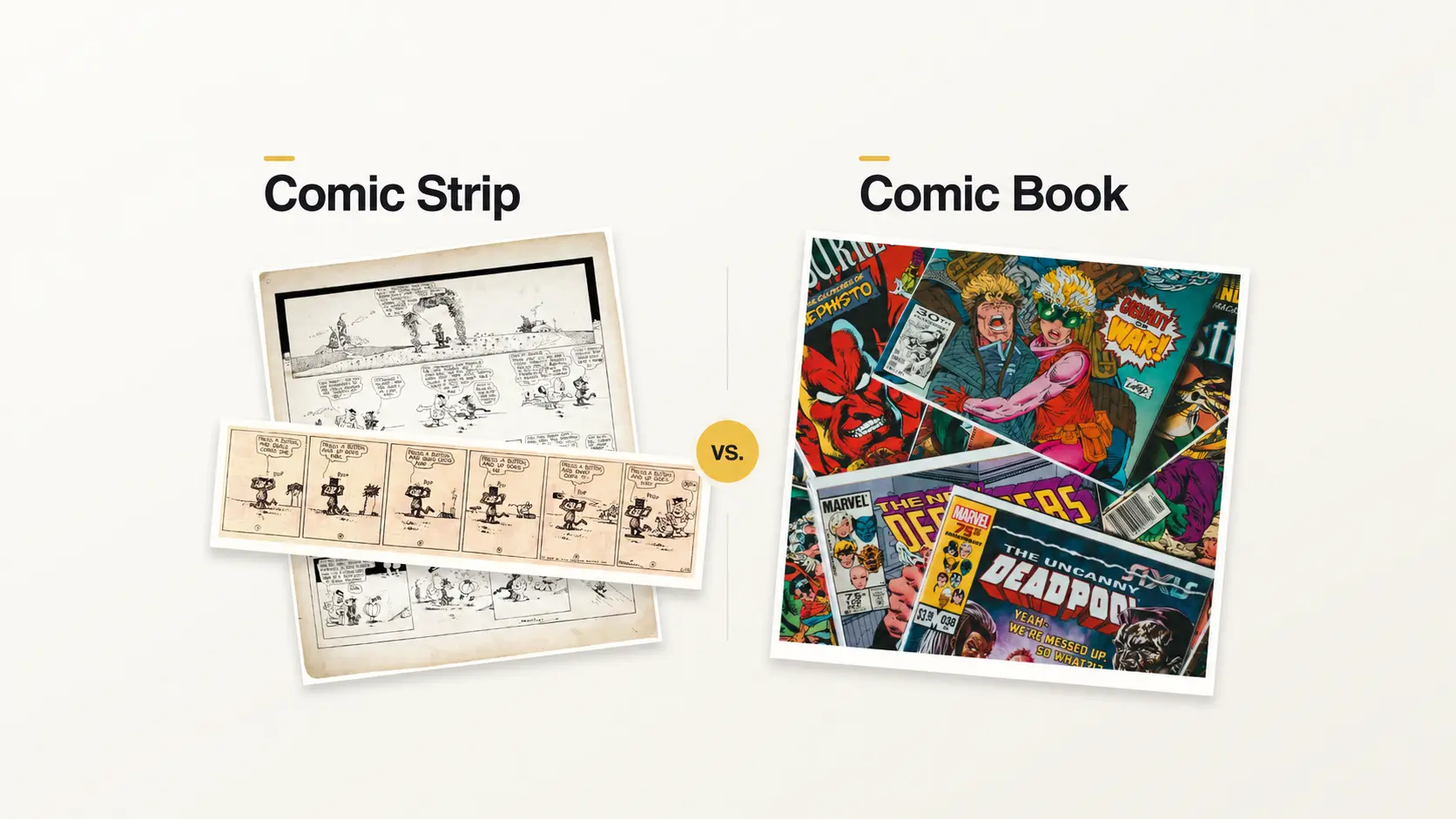

The comic strip vs comic book design decision starts with understanding how differently the two formats tell a story. Both combine illustration, dialogue, characters, and sequential visuals, but they differ significantly in length, pacing, narrative depth, and how audiences consume them.
A comic strip is a short graphic storytelling format, usually built around a single situation, message, joke, insight, or interaction. It might contain only a few panels or extend into a short social media carousel. Because the story needs to work within limited space, comic panel design has to establish context quickly, maintain a clear reading sequence, and reach the main idea without unnecessary explanation.
A comic book provides considerably more narrative space. Multiple pages allow brands to introduce characters, establish environments, develop conflicts, explain ideas, and build toward a more complete conclusion. Instead of communicating one moment, a comic book can take readers through an entire story.
Webcomics introduce a third possibility. Webcomic design is created specifically for digital consumption and may use traditional pages, horizontal panels, vertical scrolling, or episodic structures depending on the platform. Unlike a one-off comic strip or printed comic book, a webcomic can become an ongoing branded content series.
The best format therefore depends on how much story needs to be told. A short marketing message may need only a few panels, while a brand origin story or detailed educational narrative may require multiple pages.
The question is not which format is more creative. It is which format gives the story the right amount of space without making the audience work harder than necessary.
Comic strips work particularly well when a brand needs to communicate one idea quickly.
On social media, audiences often encounter content while scrolling rather than intentionally sitting down to read a long narrative. A short comic can establish a relatable situation, introduce a problem, deliver a punchline or insight, and connect it to the brand within a compact format.
This makes comic strips useful for product launch teasers, quick educational tips, relatable customer situations, campaign moments, workplace scenarios, and meme-style branded content.
For example, a software company could illustrate a common customer-support frustration in the first few panels and show the product solving it in the final panel. A consumer brand could turn a familiar everyday problem into a recurring character-based series.
Comic panel design becomes especially important in these shorter formats. There is limited room for exposition, so every panel should contribute to the message. Expressions, composition, dialogue, visual cues, and transitions need to communicate efficiently.
Comic strips can also support recurring content because an individual strip generally requires less narrative development and fewer illustrated assets than a full comic book. Once characters and the visual style have been established, brands can build a repeatable system for future stories.
That does not automatically make every strip inexpensive or fast to produce. Complexity still depends on illustration style, number of panels, characters, environments, revisions, and animation or adaptation requirements.
Within the comic strip vs comic book design comparison, choose a strip when the objective is quick engagement, a focused message, and content that can be consumed with minimal commitment from the audience.
A comic book becomes more useful when the brand story cannot be communicated effectively in a handful of panels.
Longer narratives create space for context. Brands can introduce a character, establish a problem, develop the situation, explain a product or idea, and move toward a meaningful resolution. This makes comic books particularly suitable for brand origin stories, educational campaigns, complex product explanations, and storytelling built around a larger campaign theme.
The format can also work as a campaign centerpiece rather than another individual social post.
For example, a printed branded comic book could become a trade show or event giveaway. A digital version could be distributed as a downloadable PDF, hosted on a campaign microsite, or divided into smaller pieces for social media promotion.
This additional storytelling space also changes the design process.
A longer graphic storytelling format requires more detailed scripting and storyboarding. Character appearance needs to remain consistent across pages. Locations, visual perspectives, dialogue, pacing, page turns, and comic panel design all need to work together as one narrative system.
The production investment is therefore generally higher than for a single comic strip. However, that investment may be justified when the comic is intended to become a major campaign asset or when the subject requires enough depth to make a short strip feel incomplete.
A comic book can also generate supporting content. Individual scenes, character illustrations, panels, or excerpts may be adapted into campaign posts where the creative and usage rights allow it.
When considering comic strip vs comic book design, the key question is narrative depth. If the audience only needs one memorable idea, a strip may be enough. If they need to enter a world, follow a story, understand a complex subject, or build a stronger connection with characters, a comic book provides more room to make that experience work.

The right graphic storytelling format depends not only on the story but also on where the audience will experience it. A format that works well as a printed piece may need significant adaptation for Instagram, a mobile screen, or a dedicated website.
Social media and mobile-first platforms generally favor shorter comic strips. A single image can communicate one quick moment, while a short carousel can divide the story across several frames. In both cases, comic panel design needs to remain clear on smaller screens. Dialogue should be concise, text should remain readable, and each panel should move the story forward quickly.
Comic books are better suited to platforms where audiences can spend more time with the content. Printed handouts, event giveaways, downloadable PDFs, digital publications, and dedicated campaign microsites provide more space for multi-page storytelling.
However, a printed comic book should not simply be reduced to fit a mobile screen. Page layouts designed for print can become difficult to read on a phone. If digital distribution is important, responsive or platform-specific adaptations should be considered during the design process.
Webcomic design offers another approach. A webcomic can be created as an episodic series for a dedicated website, campaign page, or digital platform. Vertical scrolling can be particularly useful for mobile reading because the story can unfold naturally as the user moves down the page.
In the comic strip vs comic book design decision, platform should therefore be considered before production begins. Knowing whether the story will appear primarily on social media, in print, as a PDF, or on the web influences panel proportions, typography, pacing, resolution, and overall storytelling structure.
Choosing between a comic strip, comic book, and webcomic becomes easier when the decision begins with the communication goal rather than the preferred illustration style.
For quick engagement and awareness, a comic strip is usually the most efficient option. The format works well when the audience needs to understand one situation, message, benefit, or joke quickly. This makes it suitable for social campaigns, product teasers, topical content, quick tips, and recurring branded posts.
For deeper brand storytelling or education, a comic book provides more narrative space. A brand can explain an origin story, introduce several characters, demonstrate a complex process, or explore a customer problem in greater depth. The longer graphic storytelling format allows information to unfold gradually rather than forcing everything into a few panels.
For ongoing audience building, webcomic design can be a stronger option. Instead of publishing one self-contained asset, the brand can develop recurring characters, situations, or themes over multiple episodes. This gives audiences a reason to return while allowing the story world to develop over time.
The decision can be simplified to three goals: quick engagement points toward a comic strip; deeper storytelling or education points toward a comic book; recurring storytelling and audience building point toward a webcomic series.
These categories are not rigid. A campaign can combine formats. A longer comic book might generate several promotional strips, while a webcomic episode could be adapted into a social carousel.
The strongest approach is to define what the audience should understand, feel, or do after reading. The format should then support that objective.
Production requirements increase as the storytelling format becomes longer and more complex.
A single comic strip usually requires a focused concept, short script, limited number of panels, illustration, lettering, and final artwork. When characters and visual styles are already established, recurring strips can also become easier to produce consistently.
A comic book involves more stages and considerably more content. The team may need to develop the narrative structure, full script, character designs, environments, page-by-page storyboards, comic panel design, final illustrations, dialogue placement, cover artwork, and production-ready files.
Continuity also becomes more important. A character's clothing, proportions, expressions, environment, and other visual details need to remain consistent across multiple pages. Changes made late in the process can affect several scenes rather than a single panel.
An ongoing webcomic series introduces a different type of investment. Individual episodes may be shorter than a comic book, but the brand needs a repeatable system for publishing consistently. Character guidelines, illustration rules, templates, episode lengths, publishing frequency, and digital specifications can help make production more manageable over time.
For this reason, there is no fixed cost difference that applies to every comic strip vs comic book design project. Pricing and timelines depend on factors such as illustration complexity, number of panels or pages, number of characters, environments, scripting requirements, revision rounds, output formats, and whether new character development is required.
Scripting complexity also scales with length. A four-panel strip may revolve around one setup and resolution. A multi-page comic needs stronger pacing, transitions, continuity, and narrative development.
The most cost-effective format is therefore not automatically the shortest one. It is the format that communicates the intended story without creating unnecessary content or restricting a story that genuinely needs more space.
The final comic strip vs comic book design decision should come from the story you need to tell, the audience you want to reach, and the platform where that story will appear.
Start with the message. If the idea can be communicated through one situation, conversation, joke, tip, or product moment, a comic strip is usually enough. Adding pages simply to make the content feel more substantial can weaken a message that works better when it is quick and focused.
If the story needs context, character development, multiple scenes, or a detailed explanation, a comic book provides more room. This is particularly useful when graphic storytelling is a central part of a campaign rather than supporting content.
Webcomic design is worth considering when storytelling needs to continue over time. Recurring characters and episodes can help create a recognizable content property instead of producing unrelated individual posts. The format can also allow a larger narrative to develop gradually without requiring audiences to consume everything at once.
Platform should influence the decision as early as the story itself. A social-first comic needs readable text, strong opening panels, and compositions that work on smaller screens. A printed comic book needs page sequencing, physical dimensions, print specifications, and page turns to be considered. A webcomic may require a completely different approach to pacing and panel arrangement, particularly when designed around vertical scrolling.
Before choosing a graphic storytelling format, consider:
Is the goal quick awareness or deeper engagement?
Can the message work within a few comic panels?
Does the story require multiple scenes or character development?
Is this a one-time campaign or an ongoing series?
Will audiences primarily experience it on social media, mobile, web, PDF, or print?
How frequently will new comic content need to be produced?
Does the budget support the required number of panels, pages, characters, and environments?
Will the artwork need to be adapted into other campaign assets?
A short comic strip is not automatically less effective than a longer comic book. Similarly, a comic book is not necessarily more engaging simply because it contains more content. The strongest format is the one that gives the story exactly the amount of space it needs.
For brands planning recurring content, it is also useful to think beyond the first execution. Establishing consistent character designs, illustration styles, typography, speech bubbles, panel structures, and brand elements can create a reusable visual system. This makes future comic panel design more consistent across campaigns and platforms.
Ultimately, the best comic strip vs comic book design choice balances storytelling ambition with audience attention, platform behavior, production resources, and the role the content plays within the wider campaign.
Abstrct’s comic design team can help brands determine whether a comic strip, comic book, or webcomic series is the right approach, then develop the storytelling structure, visual direction, characters, and final design around that format.