Most brand communication follows familiar formats: product photography, short-form video, influencer content, static advertising, or conventional explainers. Comics are used less frequently, which is exactly why they can give marketers a distinctive way to communicate.
The strongest brand comics examples show that comics are not limited to entertainment brands. Skincare companies, food brands, retailers, financial services businesses, and other organizations have used comic-style storytelling to communicate products, explain ideas, create characters, and build campaigns.
The advantage comes from combining narrative with visual communication. Instead of simply telling audiences what a product does, comics can place that product inside a situation. A customer problem can become a character conflict. A feature can become part of the resolution. A complicated subject can be divided across panels rather than explained through one large block of information.
Comics can also give brands recurring characters and a recognizable tone. When audiences repeatedly encounter the same illustration style, personalities, humor, and visual world, the format can become part of the brand's communication system.
The following comic marketing case studies are therefore more useful as strategic references than as visual inspiration alone. Each demonstrates a different reason to use comics: topical storytelling, product education, character building, entertainment, or campaign engagement.
The important question behind each example is not simply, “What did the comic look like?” It is, “Why was a comic the right format for this particular marketing message?”
Example #1: Foxtale — Turning Sunscreen Education Into a Comic Story
Indian skincare brand Foxtale used a comic-strip-style newspaper advertisement to promote its Golden Hour Glow Sunscreen. Rather than presenting the sunscreen through a conventional product advertisement, the campaign personified the sun as a character and built the product message into a humorous illustrated story. MediaNews4U
This is a useful example of how comics can make product education feel less instructional.
Sunscreen communication often revolves around familiar information such as sun exposure, protection, SPF, and product benefits. Presenting those points as another conventional skincare advertisement risks blending into a crowded category. Foxtale instead turned the problem itself—the sun—into part of the narrative.
The approach also connected the creative idea to the seasonal context of the Indian summer, giving the comic immediate relevance. Adgully
Why it works: the product has a role within the story rather than appearing as an unrelated packshot at the end. The audience first encounters a relatable problem and then sees the product positioned within its resolution.
For brands exploring visual marketing ideas, this is an important principle: do not simply illustrate an advertisement. Build a small story in which the product has a reason to exist.
Example #2: No Frills — Building a Branded Comic Universe
Canadian grocery retailer No Frills took the idea much further by developing the “Haulerverse,” a comic-inspired world built around savvy shoppers fighting high prices and unnecessary “frills.” The campaign extended through the brand’s social media and episodic comics delivered through its digital flyer. Sequential
Instead of using comics for one isolated advertisement, No Frills created a larger entertainment property around its existing brand positioning.
That distinction matters.
The comic concept translated a basic retail proposition—value-conscious grocery shopping—into characters, conflicts, and a recognizable fictional universe. Saving money could therefore be communicated through entertainment rather than repeating price-focused advertising in every execution.
The episodic structure also gave the campaign room to continue. Characters and concepts established in one execution could return later, making each piece part of a larger branded world.
Why it works: consistency creates recognition. When characters, tone, and illustration style return across multiple touchpoints, audiences can begin recognizing the content before processing the sales message.
Among these brand comics examples, No Frills demonstrates how a simple marketing proposition can become a repeatable storytelling system.
Example #3: Dr Pepper — Making the Brand Part of the Character World
A European Dr Pepper campaign used comic-strip storytelling around a group of cartoon friends and their everyday frustrations. The campaign was developed as an entertainment property extending across touchpoints including packaging, television, print, outdoor, interactive content, and a website.
The product appeared naturally within the characters’ world rather than making every story a direct product pitch. Tim Geoghegan
This demonstrates another approach to branded storytelling examples: sometimes the brand does not need to dominate every panel.
When every character exists only to explain a product benefit, the comic can quickly feel like a conventional advertisement wearing an illustrated costume. A stronger approach can be to create situations audiences actually want to follow and allow the brand to exist naturally within that world.
For Dr Pepper, the irreverent comic style also supported the personality being communicated to its intended younger audience. Tim Geoghegan
Why it works: the entertainment idea and brand personality reinforce each other. The comic is not simply an alternative visual style; it becomes a vehicle for expressing how the brand wants to sound and behave.
Example #4: Truffle Tease — Using Characters to Tease a Product Launch
Smaller brands can use the same principle without building an extensive comic universe.
For its first anniversary and the introduction of new products, home-based chocolate business Truffle Tease used a multi-stage Facebook campaign that included two comic strips featuring talking cupcakes. The characters discussed and speculated about upcoming changes before the new range was revealed. Design By Shakti
The execution turned a straightforward product announcement into a small narrative.
Instead of immediately posting new flavors and asking customers to buy them, the campaign introduced curiosity first. The cupcakes became characters, and their conversation created anticipation around what the business was about to launch.
The campaign was also adapted around Facebook’s format at the time, demonstrating that comic storytelling needs to account for the platform where audiences will actually encounter it. Design By Shakti
Why it works: comics can give even simple products a voice and personality. A cupcake cannot speak in traditional product photography, but illustration allows it to become a character.
Across these consumer-focused comic marketing case studies, the common lesson is consistency. Whether the recurring element is a fictional universe, a group of characters, a personified product, or a particular illustration style, comics give brands assets audiences can recognize over time.
That makes character consistency more than an artistic concern. It becomes part of brand recognition itself.
Example #5: Google Chrome — Explaining a Technical Product Through Comics
When Google introduced Chrome in 2008, it used a comic book to explain the thinking and technology behind the new browser. The launch comic was illustrated by Scott McCloud and covered concepts such as browser stability, security, tabs, JavaScript performance, and the broader reasoning behind Chrome. Google made the comic available publicly alongside the browser launch.
This is one of the strongest brand comics examples for technical product communication.
A browser contains many concepts that are difficult to communicate through a conventional advertisement. Instead of reducing everything to a few feature claims, the comic gave Google enough space to explain how the product worked while keeping the information visually approachable.
Illustrated characters, diagrams, conversations, and sequential panels helped break technical explanations into smaller pieces. Readers could move through the information progressively rather than facing a dense technical document.
Why it works: comics can simplify without necessarily removing substance. The format gives technical brands room to explain complex ideas through sequences, examples, and visual metaphors.
For SaaS and technology companies, the lesson is useful. Product architecture, onboarding flows, cybersecurity concepts, integrations, and complicated workflows do not always need another long whitepaper. Sometimes the right graphic storytelling format can make the same subject easier to enter and understand.
Example #6: Cisco — Turning Cybersecurity Into a Superhero Story
Cisco took a more entertainment-driven approach with The Realm, a motion-comic campaign built around superheroes representing different security capabilities. Cisco worked with Ogilvy and illustrator Mike Mayhew to create four characters facing threats such as malware and other cybersecurity problems.
The concept transformed an abstract B2B subject into a conflict audiences could visualize.
Instead of beginning with security-product specifications, the campaign created heroes, threats, and a fictional world. Cisco then connected those characters to its security solutions.
The campaign also extended beyond the comic itself. The Realm was promoted through a microsite, digital advertising, email, social platforms, and event activity. Exhibitor reported that the microsite attracted more than 80,000 visitors during its eight-week launch period, illustrating how the creative concept became a broader engagement platform rather than a single piece of content.
Why it works: cybersecurity naturally contains conflict—systems need defending against threats. The superhero format turned that existing tension into a narrative.
Among comic marketing case studies, Cisco demonstrates that B2B communication does not have to look conventionally corporate. When the metaphor fits the subject, comics can make technical brands feel more approachable without removing the underlying business message.
Example #7: Google’s Be Internet Awesome — Teaching Online Safety Through Familiar Comic Characters
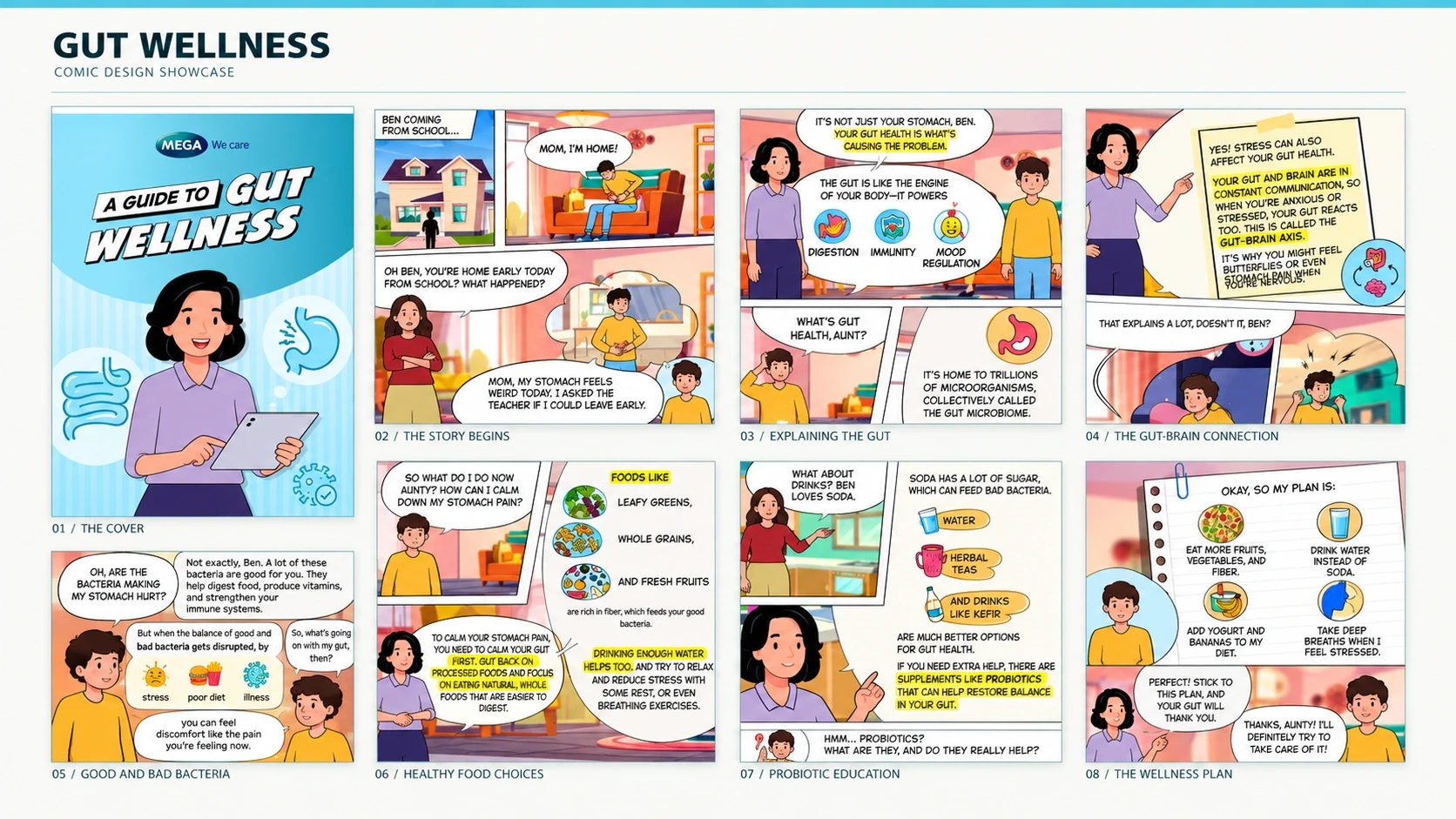
Google’s Be Internet Awesome initiative provides another approach to comic-based communication: education.
For the program’s expansion in India, Google partnered with Amar Chitra Katha to help children learn online-safety lessons through familiar comic characters and multiple Indian languages.
The program has also included comic storytelling with Tinkle characters around topics such as verifying information encountered online.
The communication challenge here is very different from selling a product.
Topics such as misinformation, privacy, cyberbullying, scams, and responsible online behavior can become abstract or intimidating when explained to children through formal instructions alone. Comics allow those lessons to be placed inside recognizable situations.
A character can make the wrong decision, experience the consequence, learn something, and demonstrate a better response. The audience sees the lesson happen instead of only reading a rule.
Google has also worked with Highlights on internet-safety content using the established Goofus and Gallant comic format to contrast less responsible and more responsible online behavior.
Why it works: sequential visual storytelling can turn an instruction into a scenario. For educational organizations, nonprofits, public-interest campaigns, and brands communicating safety information, that can make complicated guidance feel more concrete and approachable.
The broader lesson from these branded storytelling examples is that comics can be particularly useful when audiences need to understand behavior, not simply memorize information.
Example #8: Truffle Tease — Creating Launch Anticipation on a Small-Business Scale
Comic marketing does not require the production resources of Google or Cisco.
Truffle Tease, a home-based chocolate business, used talking cupcake characters in comic strips as part of a Facebook campaign around its anniversary and upcoming product additions. Instead of revealing the new products immediately, the illustrated characters discussed the changes and helped create anticipation before the launch.
This smaller-scale example is important because it demonstrates how the underlying storytelling principle can work without producing a full comic book or complex campaign ecosystem.
A business can begin with a simple recurring character, a short conversation, and a few well-designed panels. Once the illustration style and characters are established, they can potentially be reused for announcements, seasonal communication, product launches, customer situations, or educational posts.
The perceived production value can therefore be high relative to the amount of content required. However, comics are not automatically inexpensive. Cost still depends on character development, illustration complexity, scripting, number of panels, revisions, and publishing frequency.
Why it works: illustration gives small brands the ability to create their own world without needing elaborate locations, photography sets, actors, or video production for every story.
Across these B2B, educational, and smaller-business brand comics examples, the same principle appears repeatedly: comics make information easier to enter.
Google turned browser engineering into illustrated explanations. Cisco transformed cybersecurity into superhero conflict. Internet-safety initiatives turned abstract rules into relatable scenarios. A small consumer business turned cupcakes into characters.
That combination of narrative and visual clarity is what makes comics useful beyond entertainment. It allows complicated, unfamiliar, or ordinary information to become something audiences can follow as a story.
Example #9: Coca-Cola x Marvel — Turning Comic Culture Into a Collectible Brand Experience
Coca-Cola’s 2024 collaboration with Marvel shows how comic storytelling can extend beyond a traditional advertisement and become a larger physical and digital campaign.
Coca-Cola and Coca-Cola Zero Sugar bottles and cans featured bespoke illustrations of more than 30 Marvel characters. The packaging also included QR codes that unlocked augmented-reality experiences, while the wider campaign extended into a cinematic commercial, digital collectibles, merchandise, out-of-home communication, and other promotional activity.
The comic connection also reached actual comic books. Marvel released six Coca-Cola variant covers across titles including Avengers, Deadpool, Fantastic Four, Scarlet Witch, and others.
This is useful when thinking about event and experiential visual marketing ideas because the illustrated assets were not confined to one media placement. They became packaging people could collect, digital experiences they could unlock, and comic covers that placed the collaboration directly inside Marvel’s existing fan culture.
Why it works: comic-based artwork can turn a physical marketing object into something audiences may want to keep, collect, photograph, or share.
The same principle can work at a smaller scale. A brand attending a trade show could create a short printed comic related to a customer problem, industry challenge, or product story. Instead of another standard brochure, the takeaway becomes a piece of content with a narrative reason to keep reading.
Example #10: Blizzard and Overwatch — Extending a Product World Through Webcomics
In 2026, Blizzard Entertainment and WEBTOON launched Overwatch: Undivided, an original webcomic based on the Overwatch game franchise. The series was created as part of a brand and content partnership and connected directly with the game’s ongoing narrative.
This represents a different type of brand comic strategy.
Instead of explaining the product directly, the webcomic expands the world around it. Existing characters and storylines give audiences another way to interact with the franchise outside the core game experience.
For brands with established characters, fictional worlds, mascots, or campaign narratives, serialized webcomic design can provide a similar opportunity. A product launch does not necessarily have to be communicated through one announcement. Stories can be released gradually before, during, and after the campaign.
The serialized structure also creates repeat engagement. One comic strip may generate attention once, while an ongoing story can create multiple moments for audiences to return.
Why it works: serialization changes branded content from an isolated interaction into an ongoing relationship.
Among brand comics examples, this approach is particularly relevant for entertainment, gaming, lifestyle, youth-focused, and character-driven brands. However, the underlying idea can extend beyond those categories whenever a brand has enough narrative material to sustain multiple episodes.
The brands in these comic marketing case studies are very different. Some sell beverages or groceries. Others work in technology, cybersecurity, entertainment, education, or smaller consumer businesses.
Yet the strongest examples rely on four common principles: narrative, visual clarity, shareability, and brand personality.
Narrative gives information a beginning, development, and resolution. Instead of presenting isolated claims, brands can show a situation unfolding. A customer experiences a problem. A character makes a decision. A product becomes relevant. A complicated idea becomes a conflict that needs solving.
Visual clarity makes those stories easier to follow. Illustration can show relationships, emotions, environments, technical concepts, and imaginary situations that might be difficult or expensive to communicate through photography alone.
Shareability comes from designing content around how people actually consume it. Short strips can become social posts or carousels. Individual comic panels can support campaign promotion. Longer stories can become printed pieces, PDFs, web experiences, or episodic content.
Finally, comics create opportunities for stronger brand personality. Characters can be funny, frustrated, curious, confident, exaggerated, or imperfect. Illustration style, dialogue, recurring visual details, and story themes can all contribute to a recognizable brand voice.
This is why the most useful branded storytelling examples do more than place products inside speech bubbles.
They use the mechanics of comics—characters, sequencing, tension, pacing, expression, and visual storytelling—to communicate in a way that suits the message.
The lesson for marketers is not that every brand needs a comic series. It is that when information needs to become more relatable, memorable, visual, or entertaining, comics provide another storytelling system worth considering.
A brand does not need to begin with a full comic book or an ongoing webcomic series.
The right starting point might be a four-panel social comic explaining a familiar customer problem. It could be a mascot-led recurring series, an illustrated product launch, an educational comic, a printed event giveaway, or a longer digital story.
Start with the communication objective.
If the goal is quick social engagement, a short comic strip may be enough. If a product or service requires explanation, a longer sequence can create space for education. If the objective is ongoing audience engagement, recurring characters or a webcomic series can establish a recognizable content property.
The visual system should then be built for consistency. Character proportions, expressions, illustration style, typography, speech bubbles, panel layouts, colors, and brand elements need clear rules if the concept will continue across multiple pieces of content.
Distribution should also influence the design from the beginning. A comic created for Instagram will have different readability and panel requirements from a printed giveaway, downloadable PDF, or vertical-scrolling webcomic.
The strongest brand comics examples demonstrate that the format works when storytelling and marketing strategy support each other.
Abstrct’s comic design team can help develop the concept, characters, visual language, comic panels, and final campaign assets around your communication goal—whether you are creating a single branded comic or building a recurring storytelling series.