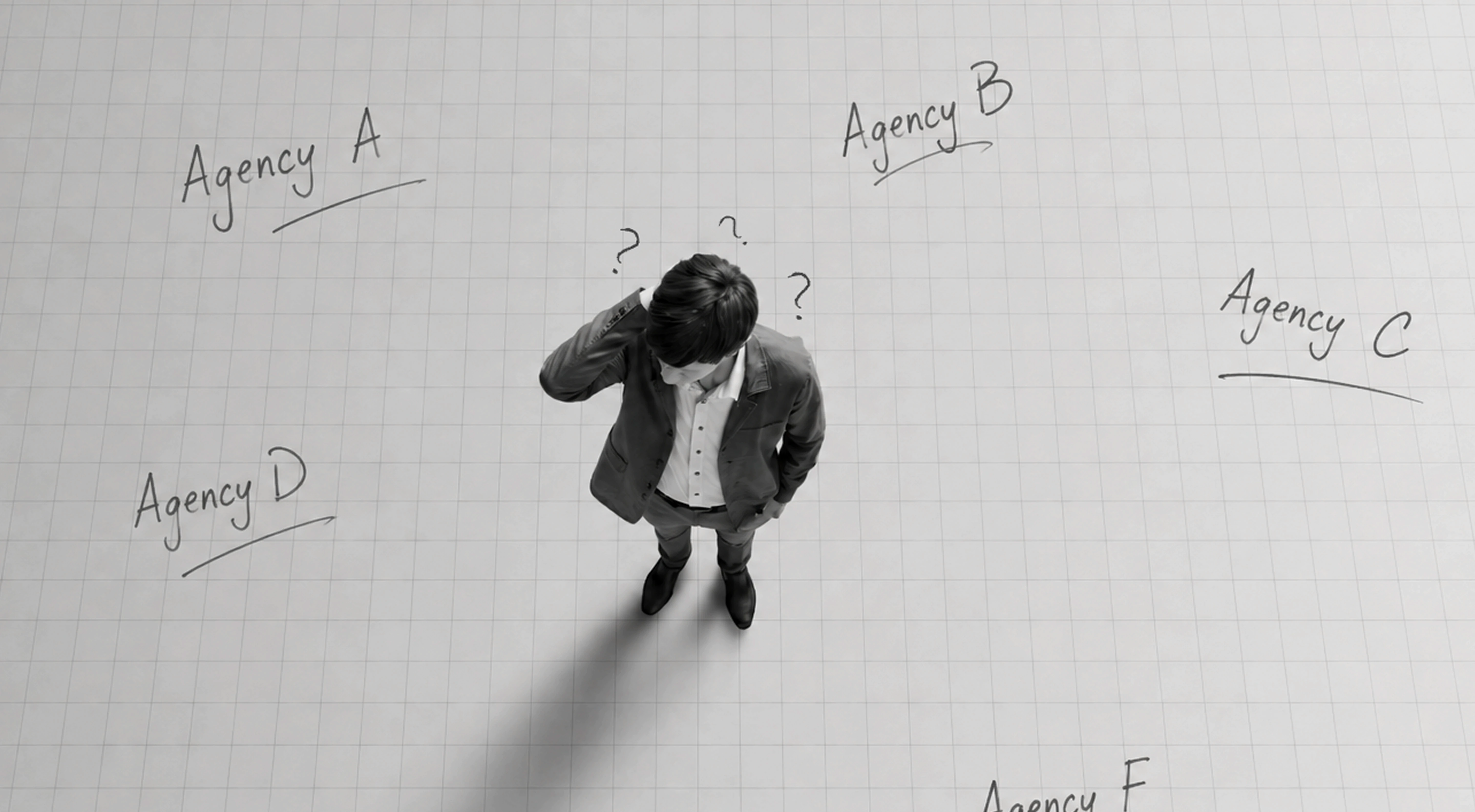
Dentaid brand & illustration case study - hero visual, abstrct design

How to Choose a White-Label Design Partner: 12 Questions to Ask

How to Choose a White-Label Design Partner: 12 Questions to Ask

How to Choose a White-Label Design Partner: 12 Questions to Ask

Published

Published

October 26, 2026

October 26, 2026

Read time

Read time

10 min

10 min

Why the Partner Choice Matters More Than Price

Why the Partner Choice Matters More Than Price

Why the Partner Choice Matters More Than Price

When outsourcing design work, choosing the lowest quote may seem like an easy way to protect your agency's margins.

But lower production costs do not always translate into better profitability.

Poor-quality work, repeated revisions, missed deadlines, and communication problems can increase the time your internal team spends managing outsourced projects.

For example, an inexpensive social media design package may become costly if your account manager needs to review and correct every creative before presenting it to the client.

A reliable white label design partner should help reduce operational pressure rather than create additional work.

The right partner can support your agency in several ways:

  • Maintain consistent creative quality across client projects.

  • Deliver work within agreed timelines.

  • Follow established brand guidelines and design processes.

  • Communicate clearly about progress and challenges.

  • Adapt to changing project requirements.

Instead of comparing prices alone, evaluate the overall value of the partnership.

A slightly higher design fee may be worthwhile when the work requires fewer corrections, less supervision, and more predictable delivery.

Quality and Capability

Quality and Capability

Quality and Capability

The first step in evaluating a potential design partner is understanding whether their creative capabilities match your clients' requirements.

A strong portfolio is useful, but relevant experience and a dependable quality-control process matter just as much.

  1. Can You Show Work Like My Clients' Work?

Ask potential partners to share examples of projects similar to the work your agency regularly handles.

If your clients are primarily SaaS companies, look for relevant experience in website design, presentations, digital campaigns, and brand identity.

If you serve consumer brands, packaging design, product campaigns, and retail marketing experience may be more important.

Pay attention to how well the work addresses different business requirements rather than judging it only by visual appeal.

You can also ask about the partner's role in each project to understand which elements they actually designed.

A partner with relevant experience may require less onboarding and be better prepared for your clients' creative expectations.

  1. Who Will Actually Design My Projects?

The person presenting the portfolio may not be the person working on your projects.

Ask whether your assignments will be handled by senior designers, junior designers, specialists, or a rotating production team.

Also clarify who will provide creative direction and manage communication.

For recurring work, having a consistent designer or team can improve familiarity with client brands and reduce repeated explanations.

If multiple designers will contribute, ask how the partner maintains consistency across deliverables.

Understanding the team structure helps you evaluate the level of expertise and supervision included in the service.

  1. How Do You QA Work Before It Reaches Me?

Quality assurance should be part of the design partner's workflow, not something your agency handles entirely.

Ask how the team reviews work before delivery.

A useful quality-control process may include checking:

  • Brand colors, typography, and logo usage.

  • Spelling, content accuracy, and visual hierarchy.

  • Alignment, spacing, and layout consistency.

  • Dimensions, resolution, and export formats.

  • Compliance with the approved brief.

For print projects, additional checks may involve bleed, margins, and print-ready file preparation.

For digital design, the review may include responsive layouts and asset specifications.

Ask who performs the final review and how errors are corrected.

A partner that can explain its QA process clearly is generally easier to evaluate than one that simply promises high-quality work.

Process and Speed

Process and Speed

Process and Speed

Creative quality alone is not enough for a successful white-label partnership.

Your outsourced design partner must also fit into your agency's delivery schedules, communication processes, and client approval workflows.


4. What Are Your Standard and Rush Turnarounds?

Ask how long the partner typically takes to complete different types of design requests.

A simple banner adaptation and a complete presentation redesign should not have identical turnaround expectations.

Request realistic delivery estimates for the services your agency uses most frequently.

Also clarify how the team handles urgent requirements.

Important questions include whether rush requests carry additional charges, how priorities are managed, and what happens when multiple deadlines overlap.

Be cautious of partners promising extremely fast delivery for every type of project without discussing complexity or capacity.

Reliable timelines are more valuable than unrealistic speed guarantees.


5. How Do Briefs, Feedback and Revisions Flow?

A structured workflow helps reduce misunderstandings and unnecessary revisions.

Ask the partner to explain the complete process, from receiving a brief to delivering final files.

Find out which information they need before starting and how they handle missing assets or unclear instructions.

Discuss how feedback should be shared, who consolidates comments, and how many revision rounds are included.

For example, your agency may prefer collecting client feedback internally and sending one consolidated revision request rather than forwarding comments individually.

The partner should be able to accommodate an agreed review process and clearly identify when requested changes fall outside the original scope.

  1. How Many Working Hours Overlap With Ours?

Time-zone compatibility can influence communication speed, particularly when your agency serves clients in different countries.

Ask how many working hours overlap with your team's schedule.

For projects requiring frequent discussions, shared working hours make it easier to resolve questions, review concepts, and approve deliverables.

For straightforward production work, asynchronous communication may be sufficient.

Also confirm expected response times, working days, holiday schedules, and availability for urgent issues.

The goal is not necessarily to find a partner working in the same time zone, but one whose availability supports your agency's workflow.

A dependable white label design partner should offer clear communication expectations and realistic delivery commitments that your team can confidently plan around.

Dentaid brand & illustration case study - design exploration visual, abstrct design

Confidentiality and Ownership

Confidentiality and Ownership

Confidentiality and Ownership

When working with an external design team, your agency may share confidential client information, unpublished campaigns, brand assets, and business documents.

A reliable white label design partner should have clear policies for protecting this information and defining ownership of the completed work.

These questions help establish trust before the partnership begins.

  1. Will You Sign an NDA and Non-Solicit?

A non-disclosure agreement (NDA) helps protect confidential information shared during the engagement.

Ask whether the partner is willing to sign an NDA covering client identities, project details, creative assets, business information, and unpublished work.

You should also discuss non-solicitation terms that address whether the partner can independently approach clients introduced through your agency.

The agreement should clarify:

  • What information must remain confidential.

  • Whether direct client communication is permitted.

  • How confidential information can be used.

  • What happens to shared information after the engagement ends.

Non-solicitation provisions should be reviewed for enforceability under applicable law.

A professional partner should be willing to discuss reasonable confidentiality and client relationship protections.

  1. Who Owns the Files and IP?

Intellectual property ownership is one of the most important aspects of a white-label arrangement.

Your agency needs to know whether it can legally transfer completed designs and associated rights to its clients.

Ask who owns the final approved artwork, when ownership transfers, and which editable source files are included.

The agreement should also address third-party assets such as stock photographs, fonts, illustrations, and licensed templates.

For example, a design partner may create an original brochure layout while using commercially licensed photography. Ownership of the layout does not automatically transfer ownership of the photographs.

Ensure the contract clearly defines intellectual property rights, permitted usage, source-file delivery, and any licensing restrictions

  1. How Do You Store and Secure Client Data?

Agencies regularly share sensitive materials, including brand guidelines, campaign plans, presentations, customer information, and internal documents.

Ask how the design partner stores, accesses, and transfers these files.

Important considerations include access permissions, secure file-sharing methods, account security, and procedures for deleting project information when it is no longer required.

You should also understand whether the partner uses subcontractors or external tools that may access client materials.

If your clients have specific security or privacy requirements, confirm that the partner can meet them before sharing sensitive information.

Clear data-handling procedures reduce unnecessary exposure and support a more dependable working relationship.

Commercials and Fit

Commercials and Fit

Commercials and Fit

Even when a design partner produces excellent work, the relationship must make financial and operational sense for your agency.

Pricing transparency, flexible capacity, and a practical trial process can help determine whether the partnership is sustainable.

  1. How Is Pricing Structured and What's Excluded?

White-label design services may be priced per project, per hour, through monthly retainers, or through dedicated design capacity.

Ask the partner to explain its pricing structure and what each arrangement includes.

For example, a monthly design retainer may cover a defined workload but exclude complex illustrations, motion graphics, or urgent requests.

Clarify whether additional charges apply to:

  • Extra revision rounds.

  • Rush delivery.

  • New design concepts beyond the approved scope.

  • Stock assets and premium fonts.

  • Editable source files.

  • Additional formats or campaign adaptations.

Understanding exclusions helps your agency prepare accurate client quotes and protect its margins.

A transparent pricing structure is more useful than a low headline price followed by unexpected charges

  1. Can You Scale Up and Down Month to Month?

Agency workloads rarely remain constant throughout the year.

Some months may involve multiple campaigns and overlapping deadlines, while others have fewer creative requirements.

Ask whether your design partner can accommodate changes in workload.

If you use a retainer, understand whether capacity can be increased or reduced and how much notice is required.

For project-based arrangements, ask how the partner handles multiple simultaneous assignments.

You should also clarify whether additional designers are available during busy periods.

A scalable partnership should provide flexibility without compromising quality or creating unrealistic delivery expectations.

  1. Will You Do a Paid Trial Project?

A paid trial is one of the most practical ways to evaluate an outsourced design partner before making a long-term commitment.

Rather than relying entirely on portfolios and sales discussions, assign a small project that reflects your agency's typical requirements.

For example, you might request a short social media carousel, a presentation redesign, or a set of campaign adaptations.

Provide a realistic brief, brand guidelines, and a defined deadline.

Evaluate the partner on creative quality, communication, attention to detail, revision handling, and final file delivery.

A paid trial also allows the design team to understand your expectations and working style.

Before beginning, agree on the trial fee, deliverables, revision limits, confidentiality, and ownership terms.

The goal is to test the actual working relationship, not simply obtain inexpensive design work.

White-label graphic design pricing depends on the type of work, expected volume, complexity, and level of ongoing support.

Agencies should choose a pricing structure that matches their workload and allows them to estimate project costs before committing to client deliverables.


Per-Project Pricing

Under this model, the outsourced design partner provides a fixed quote for a defined project.

For example, an agency may request a brochure, pitch deck, brand identity, or packaging design project.

The quote typically considers the number of deliverables, design complexity, revisions, and timeline.

Per-project pricing works well for agencies with occasional design requirements or projects that have clearly defined scopes.

However, additional deliverables or major changes may require separate charges.

Monthly Retainer

A monthly retainer provides access to an agreed amount of design capacity or a defined set of services for a recurring fee.

This model is suitable for agencies managing regular social media content, campaign creatives, marketing collateral, or ongoing client design requests.

Retainers can make monthly spending more predictable and reduce the need to negotiate every individual task.

Before signing an agreement, clarify the included workload, revision limits, turnaround expectations, and how unused capacity or additional requests are handled.


Dedicated Design Capacity

Some agencies prefer an arrangement where one or more external designers are assigned to their projects for an agreed number of hours or working days.

This approach can function similarly to an extended internal team without requiring permanent employment.

Dedicated capacity is useful when agencies have consistent workloads, established processes, and frequent collaboration requirements.

The agreement should define availability, responsibilities, communication expectations, and backup arrangements.


Hourly or Time-Based Pricing

Hourly pricing is useful for smaller tasks, design updates, and projects where the exact scope is difficult to estimate.

Agencies pay for the time spent on approved work.

However, costs can become less predictable if requirements change frequently.

A clear estimate, approval process, and time-tracking method can help control spending.

The best pricing model is not necessarily the cheapest. It is the one that provides reliable delivery while allowing the agency to maintain sustainable margins.

White-label graphic design pricing depends on the type of work, expected volume, complexity, and level of ongoing support.

Agencies should choose a pricing structure that matches their workload and allows them to estimate project costs before committing to client deliverables.

Per-Project Pricing

Under this model, the outsourced design partner provides a fixed quote for a defined project.

For example, an agency may request a brochure, pitch deck, brand identity, or packaging design project.

The quote typically considers the number of deliverables, design complexity, revisions, and timeline.

Per-project pricing works well for agencies with occasional design requirements or projects that have clearly defined scopes.

However, additional deliverables or major changes may require separate charges.

Monthly Retainer

A monthly retainer provides access to an agreed amount of design capacity or a defined set of services for a recurring fee.

This model is suitable for agencies managing regular social media content, campaign creatives, marketing collateral, or ongoing client design requests.

Retainers can make monthly spending more predictable and reduce the need to negotiate every individual task.

Before signing an agreement, clarify the included workload, revision limits, turnaround expectations, and how unused capacity or additional requests are handled.


Dedicated Design Capacity

Some agencies prefer an arrangement where one or more external designers are assigned to their projects for an agreed number of hours or working days.

This approach can function similarly to an extended internal team without requiring permanent employment.

Dedicated capacity is useful when agencies have consistent workloads, established processes, and frequent collaboration requirements.

The agreement should define availability, responsibilities, communication expectations, and backup arrangements.


Hourly or Time-Based Pricing

Hourly pricing is useful for smaller tasks, design updates, and projects where the exact scope is difficult to estimate.

Agencies pay for the time spent on approved work.

However, costs can become less predictable if requirements change frequently.

A clear estimate, approval process, and time-tracking method can help control spending.

The best pricing model is not necessarily the cheapest. It is the one that provides reliable delivery while allowing the agency to maintain sustainable margins.

Red Flags to Walk Away From

Red Flags to Walk Away From

Red Flags to Walk Away From

Choosing a white label design partner requires identifying potential problems before they affect your clients.

While no provider is perfect, certain warning signs deserve closer attention.

Unclear Portfolio Ownership

Be cautious if a partner cannot explain its role in the projects displayed in its portfolio.

Ask whether the work was created internally, collaboratively, or through subcontractors.

Unrealistic Delivery Promises

Promises of unlimited designs, immediate turnaround, or consistently perfect results may indicate unrealistic expectations.

Reliable partners should explain their capacity and acknowledge the time required for complex work.

Resistance to Written Agreements

A partner unwilling to document confidentiality, intellectual property ownership, payment terms, or project responsibilities may expose your agency to unnecessary risks.

Important commercial and legal arrangements should be agreed upon in writing.

Poor Communication During Evaluation

Delayed responses, vague answers, and missed commitments during early discussions can indicate future coordination problems.

Pay attention to how the partner communicates before the contract is signed.

No Defined Quality-Control Process

If the partner cannot explain how designs are reviewed before delivery, your internal team may end up handling most of the quality assurance.

This can reduce the operational benefits of outsourcing.

Hidden Costs and Unclear Scope
Avoid agreements where included services, revision limits, and additional charges remain ambiguous.

A dependable outsourced design partner should make it easy to understand what you are purchasing and how changes will be handled.

Recognizing these warning signs early helps agencies avoid partnerships that create more management work than they save.

Partner Scorecard

Partner Scorecard

Partner Scorecard

One of the biggest concerns agencies have about outsourcing is maintaining control over their client relationships.

A reliable white-label arrangement should establish clear boundaries around confidentiality, communication, ownership, and project responsibilities.

Use Non-Disclosure Agreements

A non-disclosure agreement (NDA) can help protect confidential client information, business strategies, campaign plans, and unpublished creative work.

The agreement should explain what information is confidential, how it can be used, and what happens when the engagement ends.

Where appropriate, agencies may also include non-solicitation provisions, subject to applicable law.

Define Client Communication Rules

In most white-label arrangements, the agency remains the primary point of contact for the client.

The outsourced design partner communicates directly with the agency rather than independently approaching the end client.

If direct collaboration is necessary, the agency should approve the arrangement and establish communication boundaries in advance.

Clarify Intellectual Property Ownership

Contracts should specify who owns the final approved designs, when ownership transfers, and whether the agency has the right to transfer those rights to its client.

The agreement should also address editable source files, licensed fonts, stock imagery, templates, and other third-party assets.

An NDA protects confidential information, but it does not automatically transfer intellectual property rights.

Agree on Portfolio Usage

External designers may want to showcase completed projects in their portfolios.

However, white-label work often involves confidential client relationships.

Agencies should establish whether the design partner can publicly display the work, mention the client, or publish case studies.

Written approval should be required where confidentiality is part of the agreement.

Protecting client relationships is ultimately about setting expectations before work begins rather than resolving misunderstandings after delivery.

Making Time Zones Work for You

Making Time Zones Work for You

Making Time Zones Work for You

After asking the 12 questions, the next step is to compare potential partners using a consistent evaluation method.

A simple white label agency checklist can help you assess providers objectively rather than making a decision based only on pricing or portfolio presentation.

How to Score Potential Partners

Rate each of the following six categories from 1 to 5:

  • Poor: Does not meet your requirements.

  • Below average: Significant concerns remain.

  • Acceptable: Meets basic expectations.

  • Good: Meets most requirements confidently.

  • Excellent: Strong capabilities and clear processes.

Six Areas to Evaluate

  1. Creative quality and relevant experience: Does the partner demonstrate work that matches your clients' requirements?

  2. Process and communication: Are briefing, feedback, revisions, and approvals clearly structured?

  3. Turnaround and reliability: Can the team meet realistic deadlines and manage urgent requests?

  4. Confidentiality and ownership: Are NDAs, client protection, intellectual property rights, and data security addressed?

  5. Pricing and transparency: Are costs, exclusions, and revision policies clearly explained?

  6. Scalability and flexibility: Can the partner support changing workloads without compromising delivery?

Add the scores to calculate a total out of 30.

Understanding Your Score

26–30: Strong potential fit. Consider moving forward with a paid trial.

  • 21–25: Promising option. Clarify any remaining concerns.

  • 16–20: Requires further evaluation before committing.

  • Below 16: Consider exploring alternative partners.

These scores are a practical decision-making guide rather than an industry standard.

Even a high-scoring partner may not be suitable if it cannot meet essential requirements such as confidentiality, technical expertise, or delivery timelines.

Use the scorecard to shortlist providers, then validate your assessment through a real project

How Abstrct Answers These 12 Questions

How Abstrct Answers These 12 Questions

How Abstrct Answers These 12 Questions

Finding a reliable white label design partner involves understanding how the team approaches creative work, collaboration, and project delivery.

Abstrct Design offers creative services that agencies can explore for outsourced and white-label requirements.

Rather than assuming every agency needs the same arrangement, the partnership should be evaluated against the specific requirements covered in this checklist.

Creative Capabilities and Quality

Agencies can review Abstrct's relevant work across services such as brand identity, presentation design, packaging, print design, social media design, and UI/UX design.

During the evaluation, it is important to discuss the type of projects your agency handles, the expected creative standards, and the review process required before delivery.

Workflow and Communication

Every agency has different briefing methods, project management tools, approval processes, and turnaround expectations.

An initial discussion can establish how briefs will be shared, who will coordinate the work, and how revisions and final deliverables should be managed.

These arrangements should be confirmed before production begins.

Confidentiality and File Ownership

White-label partnerships often involve confidential client information and unpublished creative work.

Agencies should discuss NDA requirements, client communication boundaries, intellectual property terms, and source-file delivery during the evaluation process.

Any agreed protections and ownership arrangements should be documented in writing.


Pricing and Capacity
Some agencies need support for individual projects, while others require ongoing creative capacity.

The appropriate commercial arrangement depends on the services required, project complexity, delivery frequency, and expected workload.
Agencies can discuss these requirements with Abstrct to explore a suitable scope and pricing structure.

Evaluating the Partnership
Before committing to a long-term arrangement, agencies can ask about the possibility of a paid trial project.

A clearly scoped trial provides an opportunity to assess creative quality, communication, responsiveness, and delivery expectations.

The purpose is to establish whether both teams can work effectively together before expanding the relationship.

Choosing a white label design partner should be based on demonstrated capabilities, transparent agreements, and practical compatibility rather than promises alone.

FAQ

FAQ

FAQ

How Long Should a Trial Project Be?

A trial project typically takes a few working days to two weeks, depending on complexity, and should include enough work to evaluate quality, communication, revisions, and delivery.

Will My Clients Know I Outsource?

Clients do not necessarily need to interact with your outsourced design partner, but disclosure depends on your client agreements, confidentiality obligations, and any applicable requirements.

What Is a Fair Revision Policy?

A fair revision policy usually includes one to three defined revision rounds, with clear terms for additional changes and requests outside the approved scope.

Should the Partner Work Inside My Project Management Tool?

Using your agency's existing project management tool can improve visibility and coordination, but the arrangement should be agreed upon based on access requirements, security, and workflow compatibility.

Can I White-Label Motion and Packaging Too?

Yes, motion graphics and packaging design can be white-labeled when the partner has the necessary expertise, tools, and production processes to deliver those services.

Recomended blogs

Recomended blogs

Recomended blogs

Brand Identity Design

Brand Identity Design

Logo vs Brand Identity:

What's the Difference?

Logo vs Brand Identity: What's the Difference?

Logo vs Brand Identity:

What's the Difference?

June 24, 2026 | 10 min read

June 24, 2026 | 10 min read

Packaging Design

Brand Identity Design

7 Reasons why good design is crucial for brand

Brand Identity vs Design System: What's the Difference?

June 24, 2021 | 10 min read

June 24, 2026 | 10 min read

Packaging Design

Brand Identity Design

7 Reasons why good design is crucial for brand

How to Choose a Brand Identity Design Agency

June 24, 2021 | 10 min read

June 24, 2026 | 10 min read

Brand Identity Design

Brand Identity vs Design System: What's the Difference?

June 24, 2026 | 10 min read

Brand Identity Design

How to Choose a Brand Identity Design Agency

June 24, 2026 | 10 min read

Book a partner call

Book a partner call

Book a partner call

Get valuable strategy, culture, and brand insights straight to your inbox.

By signing up to receive emails from Abstrct Design, you agree to our Privacy Policy. We treat your info responsibly. Unsubscribe anytime.

© All rights reserved Abstrct Design - 2026

Get valuable strategy, culture, and brand insights straight to your inbox.

By signing up to receive emails from Abstrct Design, you agree to our Privacy Policy. We treat your info responsibly. Unsubscribe anytime.

© All rights reserved Abstrct Design - 2026

Get valuable strategy, culture, and brand insights straight to your inbox.

By signing up to receive emails from Abstrct Design, you agree to our Privacy Policy. We treat your info responsibly. Unsubscribe anytime.

© All rights reserved Abstrct Design - 2026